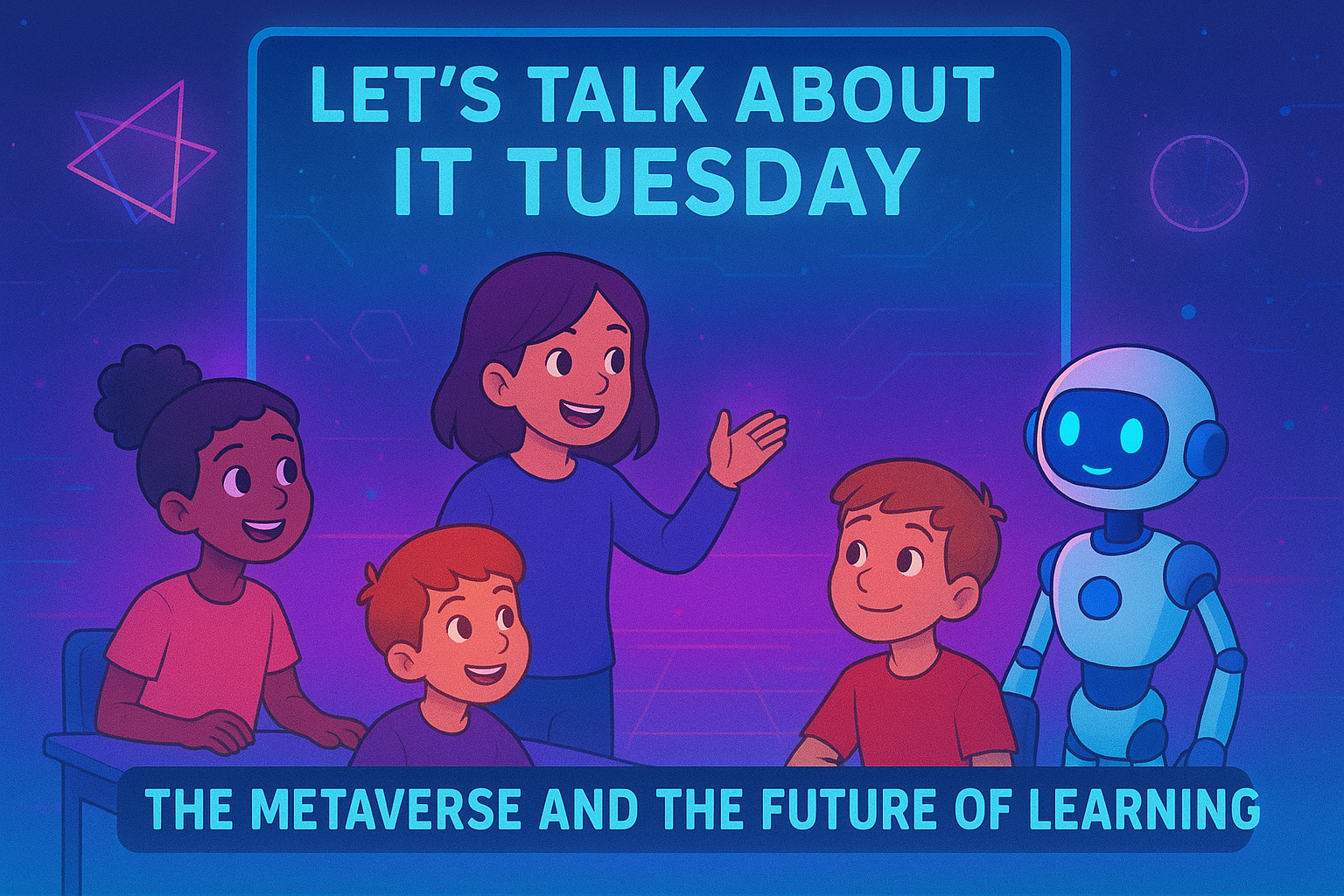

Let’s Talk About It Tuesday: The Metaverse and the Future of Learning
Let’s Talk About It Tuesday:
The Metaverse and the Future of Learning

Let’s Talk About It Tuesday:
The Metaverse and the Future of Learning
When we talk about STEAM, we usually imagine classrooms full of experiments, projects, and hands-on learning. But what if those classrooms expanded beyond walls, into a completely virtual world? That’s the idea behind the metaverse, a digital universe where students can explore, build, and learn through immersive experiences.
Today, let’s talk about how the metaverse is transforming education and why it may redefine what learning looks like.
Technology: Building a New Dimension of Learning
The metaverse uses virtual reality (VR), augmented reality (AR), and artificial intelligence (AI) to create 3D environments where students can interact with lessons, not just read about them.
Imagine walking through the solar system, exploring the inside of a human cell, or building a bridge in virtual space, all from your desk. This technology brings learning to life, allowing students to “experience” knowledge instead of memorizing it.
Engineering the Virtual World
Behind every metaverse experience are engineers and developers who combine coding, design, and data systems to make learning possible. They build digital classrooms, realistic simulations, and interactive avatars that allow students to collaborate from anywhere in the world.This fusion of engineering and creativity makes education both more engaging and more inclusive.
Art: Designing the Experience
The metaverse relies on design, the colors, motion, sound, and interactivity that make a digital world feel real. Artists and designers create the virtual environments that turn a lesson into an adventure. Their work helps students not only learn but feel emotionally connected to the material.
It’s the perfect example of art and technology working hand in hand.
Science and Math at the Core
Even in the virtual world, science and math power everything behind the scenes.
Physics determines how objects move. Math defines how light reflects and how data flows.
Together, they make every simulation behave like reality. Without STEAM’s foundation, the metaverse would just be imagination, it’s science and math that make it interactive, accurate, and meaningful.
STEAM in Action: Learning Without Limits
Schools are already using the metaverse for:
- Virtual field trips to museums and outer space.
- Digital chemistry labs where students can safely experiment.
- Architecture projects built and tested in VR.
- Global collaboration between classrooms in different countries.
It’s education that crosses boundaries and inspires curiosity.